
Just because AI can create something does not mean that it should.
Cyberbullying is no longer limited to cruel comments, fake accounts, screenshots, or group chats. With AI tools, students can now create fake images, videos, and voice recordings that make it look or sound like someone did something they never did.
That is why AI deepfake bullying in schools is one of the fastest-growing forms of cyberbullying. A fake image can be created in minutes, shared in seconds, and cause real harm long after the person who made it claims it was “just a joke.”
For parents and educators, this is not only a technology issue. It is a safety issue. It is a consent issue. And it is a new form of online bullying that families, schools, and students need to understand.
A RAND report found that 13 percent of K-12 principals surveyed said they had seen bullying incidents involving AI-generated deepfakes in recent school years. As AI tools become easier to access, parents need to know what deepfake cyberbullying can look like, how to respond, and how to talk to kids before harm happens.
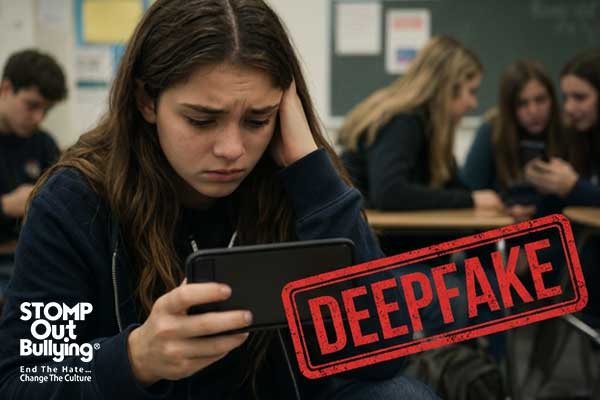
This scene, where an anonymous girl at school appears distressed by what she sees on her smartphone, was generated entirely by AI as an example of how realistic a deepfake can appear.
What Is AI Deepfake Bullying?
An AI deepfake is a fake image, video, voice recording, or other piece of digital content created or altered with artificial intelligence to make it appear real.
In a school setting, deepfake bullying may include:
- A fake nude or sexualized image of a student
- A student’s face placed on another person’s body
- A fake video created to embarrass or humiliate someone
- A cloned voice used to make it sound like a student said something they never said
- A fake profile or account using AI-generated images
- A manipulated image or screenshot used to spread rumors
This kind of AI-generated bullying can be especially damaging because it attacks a young person’s identity, reputation, body, and sense of safety. Even when the content is fake, the shame, fear, and humiliation can feel very real.
The National Center for Missing & Exploited Children (NCMEC) warns that generative AI can create images, videos, audio, and text, and that this technology is being used in ways that can sexually exploit and harm children. That is why parents and educators should take fake images of students seriously, especially when the content is sexualized, threatening, or designed to humiliate.
Why “Fake” Does Not Mean Harmless
One of the most important things parents and educators need to understand is this: fake does not mean harmless.
Adults may focus on whether the image is real. Kids and teens are often dealing with something much bigger. They are thinking about who saw it, who shared it, who laughed, who believed it, and how they are supposed to walk into school the next day.
A fake image can still damage a student’s reputation. A fake video can still make them feel unsafe. A fake voice recording can still create fear, confusion, or consequences. An AI-generated nude image can still feel violating, even if they never took or shared a photo.
Parents should make it clear from the beginning: if someone uses AI to create or share a fake image of your child, your child is not at fault. The responsibility lies with the person who created it, shared it, threatened to share it, or helped it spread.
What to Do If Your Child Is Targeted by a Deepfake
If your child is targeted by a deepfake, your first response matters. Your child needs to know they are believed, protected, and not alone.
1. Stay calm and believe your child
Start with reassurance, not questions that sound like blame.
You can say:
“I’m so sorry this happened. You are not in trouble. We are going to handle this together.”
Even if you feel panicked or angry, try not to let that be the first thing your child sees. If they are already feeling ashamed or afraid, your calm response can help them feel safer telling you what happened.
2. Save evidence carefully
Document what happened before the content disappears. Save screenshots, usernames, dates, times, platform names, URLs (if available), and the names of students or accounts involved.
If the content is explicit or sexualized and involves someone under 18, use extra caution. Document only what is necessary and avoid sharing or repeatedly forwarding the content. If possible, ask the school or law enforcement how they would like evidence preserved before sending it to others.
3. Report it immediately
Report the content on the platform where it appeared as soon as possible. Depending on the situation, report it as harassment, impersonation, nonconsensual intimate content, or child sexual exploitation. Save confirmation emails, report numbers, or screenshots showing that you submitted the report.
4. Contact the school
If students from school are involved, contact the school immediately. Ask who will handle the report, how your child will be protected from retaliation, and what steps will be taken to stop further sharing.
You can ask:
- Who is the point person for this report?
- How will the school prevent further sharing?
- How will my child be protected at school?
- Will this be documented as cyberbullying, harassment, or abuse?
- What support is available during the school day?
- How will students be reminded not to save, share, forward, laugh at, or discuss the content?
The school response should not depend on whether the content is “real.” AI-generated bullying can still affect a student’s safety, attendance, friendships, mental health, and ability to learn.
5. Use trusted reporting and removal resources
Start with STOMP Out Bullying’s cyberbullying resources for guidance on recognizing and responding to online bullying.
If explicit or sexualized images of a minor are involved, NCMEC’s Take It Down may help prevent the content from being shared online or help participating platforms remove it. If there are threats, extortion, online enticement, or suspected child sexual exploitation, families can also report to NCMEC’s CyberTipline.
The Federal Trade Commission has explained that the TAKE IT DOWN ACT covers nonconsensual intimate imagery, including digital forgeries created or altered with artificial intelligence. Covered platforms must remove qualifying intimate images or videos and known identical copies within 48 hours of a valid request.
Laws and school policies may vary, but the bottom line is clear: creating, threatening to share, or spreading intimate deepfakes is not harmless.
6. Support your child emotionally
Do not assume your child is okay because the content is fake. Deepfake bullying can leave a child feeling exposed, powerless, embarrassed, and afraid.
Parents may notice sudden anxiety around school, panic after checking a phone, withdrawal from friends or activities, sleep changes, or comments that suggest shame, fear, or hopelessness.
Check in more than once. Let your child know they do not have to manage this alone.
When to Get Emergency Help
If your child talks about self-harm, suicide, not wanting to be here, or feeling like their life is over, do not wait. Stay with them, remove immediate dangers when possible, and reach out for professional support right away. In the United States, you can call or text 988 for the Suicide & Crisis Lifeline. If you believe your child is in immediate danger, take them to the emergency room or call emergency services.
How to Talk to Kids About AI, Consent, and Digital Harm
Parents do not need to understand every AI app to have a meaningful conversation with their child. The most important conversation is not about technology. It is about consent, empathy, and harm. These conversations should also include how kids use AI chatbots and what they may share during those interactions. Read our blog "AI Chatbots Are Becoming Your Child’s Best Friend: What Parents Need to Know" to learn more about talking with kids about AI chatbots.
Start with simple, direct messages:
Just because AI can create something does not mean it should.
Using someone’s face, body, voice, name, or image without permission can be harmful. In some cases, especially when AI is used to create or share sexualized images, threats, impersonation, or harassment, it may also be illegal.
Creating a fake image “as a joke” can still be bullying.
Sharing a deepfake makes the harm worse, even if you did not create it.
If someone sends you a harmful image, do not forward it. Do not add a laughing emoji. Do not ask to see more. Save what you need to report it, leave the conversation if possible, and tell an adult.
You can ask:
- Have you seen people use AI to make fake images or videos?
- Do kids at your school think deepfakes are funny, harmful, or both?
- What would you do if someone sent you a fake image of a classmate?
- Do you know who you would tell if someone used AI to hurt you or someone else?
These conversations should not be one-time lectures. They should be part of ongoing digital safety conversations, just like conversations about texting, social media, privacy, and cyberbullying in schools.
How to Be an Upstander in the Age of AI
Students also have an important role to play. In the age of AI, being an Upstander means refusing to help harmful content spread.
If a student sees or receives a deepfake, they can:
- Refuse to share it
- Refuse to laugh at it
- Refuse to ask to see it
- Leave the group chat if people are piling on
- Report the post, account, or message
- Tell a trusted adult
- Reach out to the person targeted and let them know they are not alone
- Encourage others not to forward, save, or discuss the content
An Upstander does not have to confront everyone in the moment. Sometimes the safest and most powerful thing a student can do is stop the spread, get help, and support the person being targeted.
AI may be changing the way cyberbullying happens, but kids still need what they have always needed: adults who believe them, schools that act, and communities that refuse to spread harm.
Every day, students are facing bullying, harassment, and online harm;
often without support. Help us reach them before it escalates.
Follow STOMP Out Bullying